
Class in winter
I've missed out in recent years.

I am back from a week away teaching at Peter Galbert’s shop in Berwick, Maine. That means, directly after teaching, there are a few days where I can hardly form words, let alone put together sentences. Then I come out of it and am a functioning human again.
I realized that this was the first winter class I’ve taught in at least a dozen years. There is one primary reason for that; winter comes with additional weather risks. I didn’t schedule winter classes while running Pine Croft…we shut things down, made shop improvements, and waited for the redbuds to return. I haven’t taught them in my shop here in Waldoboro (though maybe in the future). I simply take a few months off to focus on other things - making, more writing, and a little space to recharge.
But we stuck a mid-February class on the schedule and it was ideal. The class, simply put, was full of energy and enthusiasm and good work, while outside the shop it was grey and snowy. It was a mid-winter craft accelerator. I hadn’t realized what I was missing by avoiding classes in the winter. I’ll add more in future years.
A few highlights from the week:
Joel Paul assisted and shared his green woodworking experiences from a spoon carving perspective. He’s worked different woods, in different ways, than I have. Joel’s knowledge was a strong supplement to the chairmaking focus of our week.
Peter Lamb stopped by one afternoon and kindly shared about Bill Coperthwaite, Dickenson’s Reach, and his work on birch containers. That was an unexpected surprise.
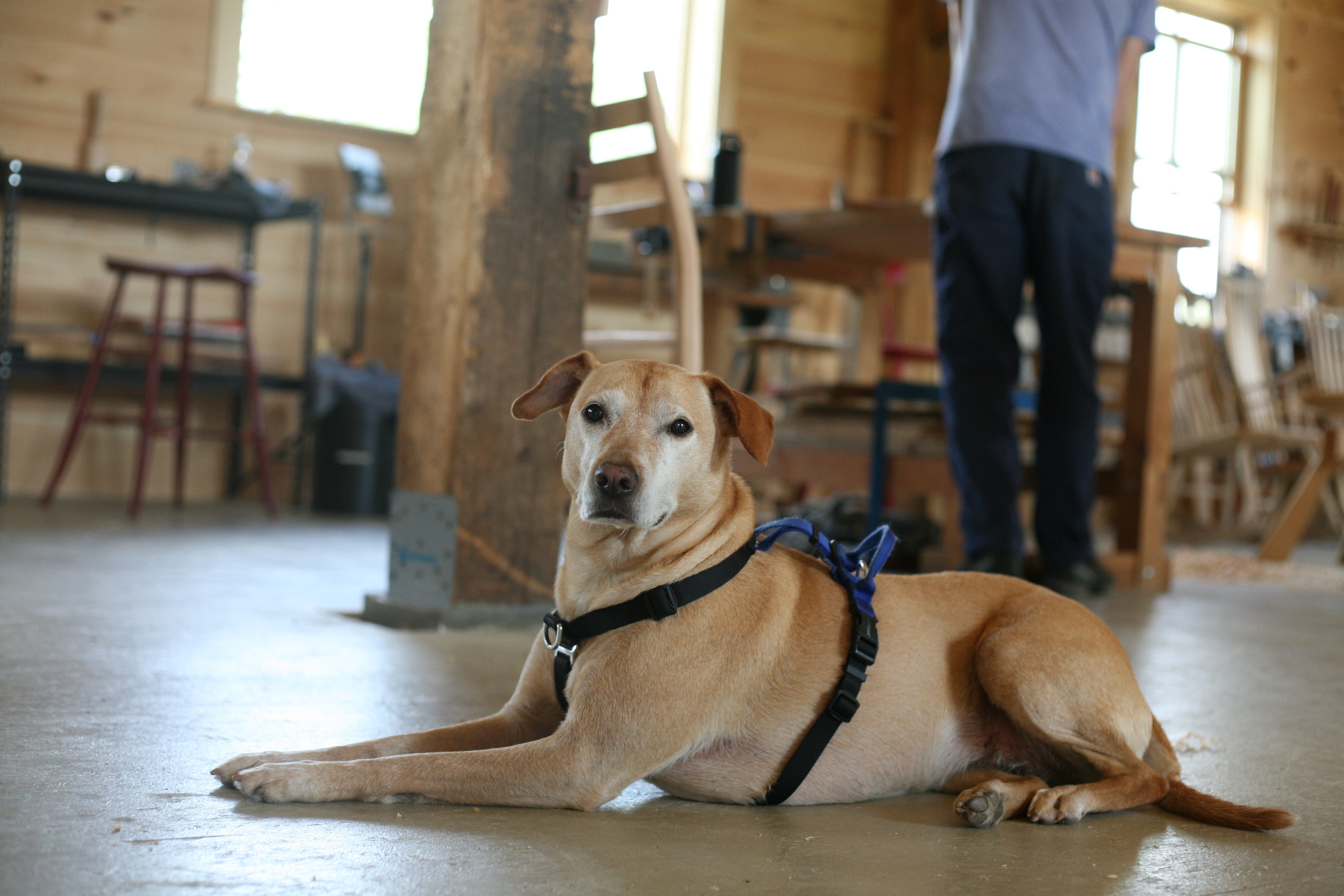
Peter Galbert dropped in for quick sharpening demonstrations and the visits with Georgia (the most famous and most photographed dog in chairmaking).
I’ve shared this before, and I’ll mention it again now. There’s the old, condescending saying that ends in, “..those who can’t teach.”
Whoever uttered that phrase hasn’t taught a chairmaking class.
As an instructor, it is an enjoyable highwire act from start to finish. There are possibilities for challenges, issues, and misdirections around every corner. But the biggest challenge, for me, is with knowledge. There is always more space for more knowledge and understanding. It will take a lifetime.
And that knowledge is key, because questions come from every direction during a chair class.
Which steel is better?
Why grind at this angle?
What happens if…
A mortise went awry…what’s the bestest, fastest fix?
Is (tool brand X) better than (tool brand Y)?
Does this look right? Or does it look horribly wrong?
The next question could come from any direction. On any woodworking topic. I, of course, only know a handful of things about woodworking. It’s a humbling dance at times.
There is a balance between making and teaching. I’m always working on that balance. Both making and teaching are vital. The classes spur me towards more knowledge, which, in turn, makes me a better instructor and woodworker.
I was looking forward to the week in Berwick. The creative jolt in the middle of winter was a welcomed surprise.
Andy, appreciate your thoughts. Sounds like a great week. I hope the recovery goes well. :-)
Thanks for sharing.. Very motivational