
Sharpening Drill Bits
A skill avoided for 15 years

There’s a question at the bottom for anyone with a good source for bending straps
[In this post, I share about sharpening drill bits. Everything I know, and it’s not much, comes from Peter Galbert’s efforts on the subject. Peter is a friend and I occasionally teach at his school. This is not a “sponsored post” or anything of the sort.
Just want to mention this at the start.
Also, I am not an influencer in any form. I have never been approached to promote a product for compensation. If anything, it’s more likely I’ll be approached to be an “anti-influencer.”
What’s an anti-influencer?
In my mind, it works like this. A brand (Titebond, in this fake example) reaches out about a potential partnership;
“We’ve seen your work. We have an offer for you. We’ll give you a yearly stipend$ if our glue NEVER appears in any of your pictures or videos. We’ll pay you as long as no one knows you use our product.”
Anyway, onto the post…
When I first heard of a chairmaker grinding drill bits, my thoughts were instinctually repulsive.
I was attempting to learn chairmaking - an already overwhelming prospect. Now I find out I also need to grind my own bits. Why? There are bits everywhere. And for a few dollars. Of all my concerns learning the craft, it felt that grinding bits were the least of my concerns.
But, over time, that interest changed. It changed for a few reasons:
As my chairmaking abilities improved, I started drilling at severe angles. Standard bits don’t thrive (or provide good results) at significant angles. I wanted better results than I was achieving with woodworking store bits (forstsner and brad points).
At long last, my budget and desire for better bits aligned. Getting started, I had some many needs, and so little money, that investing in grinding bits seemed a poor use of resources. I have the basics now. I have an extra grinder. And I was willing to invest in the quality wheel.
My drawer of dull and retired bits has grown over the years. Why not refresh instead of continually purchasing new bits? There’s a lot of quality steel just sitting, neglected, in the junk drawer.
The first thing learned with other cutting tools - hand planes, drawknives, etc. - was how to maintain them. I should do the same with this cutting tool.
After watching Peter demonstrate bit grinding a few weeks ago while teaching at his shop, I returned home and purchased the recommended 120 grit CBN diamond grinding wheel (The link is to Peter’s substack. He’s covered the subject in recent months).
This purchase forces my hand. I’ve now spent money. Better put it to use (or eventually put the diamond wheel in the garage alongside the mandolin and the cross country skis…other things that “didn’t stick”).
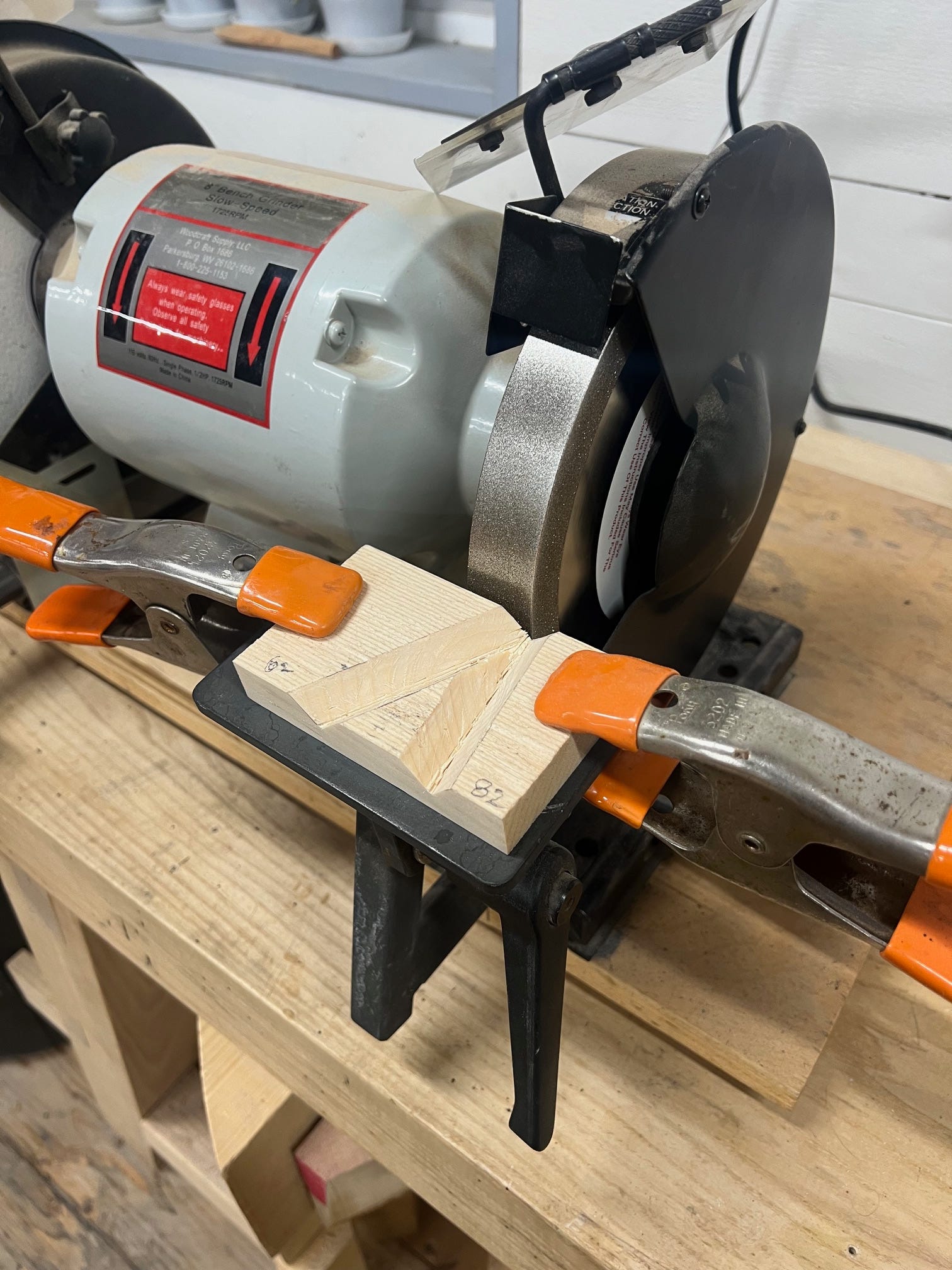
Then, a couple of days ago, necessity pushed me forward. I’m currently in the middle of a stick chair build and want 9/16” mortises on the arm bow. I’ve never used 9/16” mortises and did not own a bit that size. My options…find something online or make the ideal bit.
I picked up a 9/16” HSS twist bit from the hardware store. I made the angled holding platform in Peter’s videos. And, working from memory, I had a quality bit in about 10-15 minutes. Not perfect - there’s nuance needed and surely I forgot an important procedural step - but the bit cuts well, despite my fumbling. Clean, crisp entry holes at strong angles. The exit hole creates some blowout, and the necessity of the backer board…which should improve as I better understand the relationship between grinder and cutting angles. I’m a novice at this - there’s much to learn as I rehab other bits from my junk drawer. Plenty of chances ahead.
In short, I have a quality bit in a short amount of time and something I can maintain over the years. I’m excited to see what’s possible.
My drill bit needs are sometimes different from those shared (in videos) by Peter. Most post and rung mortises are stopped. I want a bit that allows significant angles (meaning long leader and pushed back wings), yet has a short-ish center brad, so that it doesn’t poke out the opposite face of the chair. I know just enough to experiment going forward.
Also, an aggressively ground brad point bit sometimes “grabs” the wet oak and pulls itself into the cut. That bit may be ideal for dry maple but too jumpy for greenwood. Now I can adapt the bits to the material.
It only took about 15-20 years to get to this starting point.
Online sources for quality bits:
Wood Owl bits
Kyle Barton (bbcustomtools.com)
Felix Bouchet (felixbouchet.com)
My bending strap question:
I would appreciate recommendations for steel straps for chair bending forms.
I’ve preferred the straps sold by Lee Valley. Those straps are no longer available online (I don’t know why…if it’s tariff related or another issue). I cannot obtain them.
I believe the LV straps are around 8 gauge steel. Ideally the straps are 1 1/4 - 2” wide. I’m looking for 30-50 ft worth. (Not the pallet load quantities that I find online).
Does anyone have a good source for purchasing small quantities of steel strapping?
One more thought on the Simpson strong ties—I line them with felt and have never gotten dimples.
Last month my LV strap order was cancelled. Their customer service desk told me that since they were unable to verify the source of the steel(and have the tariff correctly calculated) that they could not ship to US.