
Know Thy Audience
Deciphering Furniture Feedback

[A few quick notes; the lounge chair series will slow in the coming weeks. Starting tomorrow, Charles Thompson and I are leading a stick chair class, then there’s an upcoming holiday. It’ll return to its weekly pace in December.
Also, I intend to have my 2026 class schedule available in the coming weeks (at least for the first half of the year). There are still a few details coming together. I plan on teaching here in Maine, and travel to New Hampshire, Kentucky, and Boston, MA in the coming year.
One more; Handworks is returning in September, 2026. The Benchcrafted fellows are again throwing their hand tool woodworking festival in Amana, Iowa. It’s a blast...woodworkers, tool makers, used tool vendors, educational opportunities, all in the Iowa heat. I hope to see you there.]
This post is a confluence of a few ideas. Business, livelihood, design, and probably a little imposter syndrome. Hopefully the ideas mingle smoothly. We’ll see how this post turns out in the end.
Because I’m writing a book on business*, I attract questions about the business end of woodworking. Both that and because I have worked in the woodworking field for a while now. Questions come in about marketing and strategy and finding customers. I am the wrong person to ask (I have to hold back laughter when being asked…if only the person knew how poor I was at all of this)…but I offer what I have learned and observed over time.
I often share that I do three things for livelihood; make, teach, and write. I straddle some imaginary line between education and making. Each of the three compliment one another. Each aspect helps another aspect.
But it’s not a harmonious compliment. When I teach, it becomes difficult to write (actually, it’s always difficult to write…but that’s on me more than the circumstances). Writing, and the space it requires, will limit shop time.
And then there’s this, and I only understand it to an extent. The audiences are often different between making, teaching, and writing.
Here’s what I mean: Commissions, orders, or other $$$ sales. On the making side, the work needs to find the interested party, or there must be an established relationship where the customer returns. For my work, the audience must find the work and have an avenue to purchase it. That usually means putting my work in front of them.
The internet makes it easier to share the work (I’m guessing this is the reason less furniture makers attend craft shows than previous generations). Easier, but it also falls into void. It is lost in the noise. I think of my website (and instagram, to an extent) as simply proof of my existence. They lead to some sales, but I’m much more successful when interested customers see my work, touch the furniture, sit in the chairs, and visit the shop.
I have yet to have a sale where someone says, “I found you through your website.” The next time will be the first. But someone finds my work, then visits the site, then reaches out. The website is a needed component, but doesn’t drive sales.
And yet, if I’m not careful, the sales part of my business completely falls off. I won’t leave the shop, won’t advertise or market, won’t host an open house. Then, after six months of quiet, I’m surprised that my phone isn’t ringing and inquiries aren’t coming in.
And I remember, I haven’t put any energy towards sales for a stretch….
What follows are a few observations..
I make chairs that I find interesting. Rocking chairs, side chairs, a lounge chair, arm chairs, etc. When I make something new, it may find a response from the woodworking-interested audience (likely the audience that reads here on Substack and follows me on IG). Sometimes commissions and orders come directly from these sources, but it’s more likely the audience is interested in the educational or craft side. The chairs may excite the making audience. They ask questions, share comments, and may end up joining me in a class to make a chair.
But that same chair may confound the general public. It may be too odd and too unexpected.
I’ve had visitors to the shop (who find me on the internet) completely confused at what I do. They expect a line of furniture, maybe a showroom, and some inventory to choose from. I have none of that.
There are different conclusions I could draw from this;
that they’re the wrong audience
that they’re the right audience, but I’m the wrong maker for them
that my website does a poor job of reflecting me (this one’s probably accurate)
I should adapt to better serve these interested people.
The last point, to adapt to better provide, is the one I think about (along with the better website…). I could make a chair or two, clearly dining chairs (maybe even named “dining chair”), to better aid a visitor. Furniture needs context, and sometimes it’s difficult to envision the context when visiting a shop. There are local shops who do a much better job at this than me. But do I want to make this change? To spend this energy?
I haven’t figured this one out just yet….
Another observation: it seems that some chairs find a stronger foothold within the craft world than amongst the buying public (and, of course, there is overlap between the craft world and the buying public). And vis-versa; a chair may have a robust commercial audience and little craft community interest.
I think of the Alexander chair. (A beautiful two-slat ladderback).
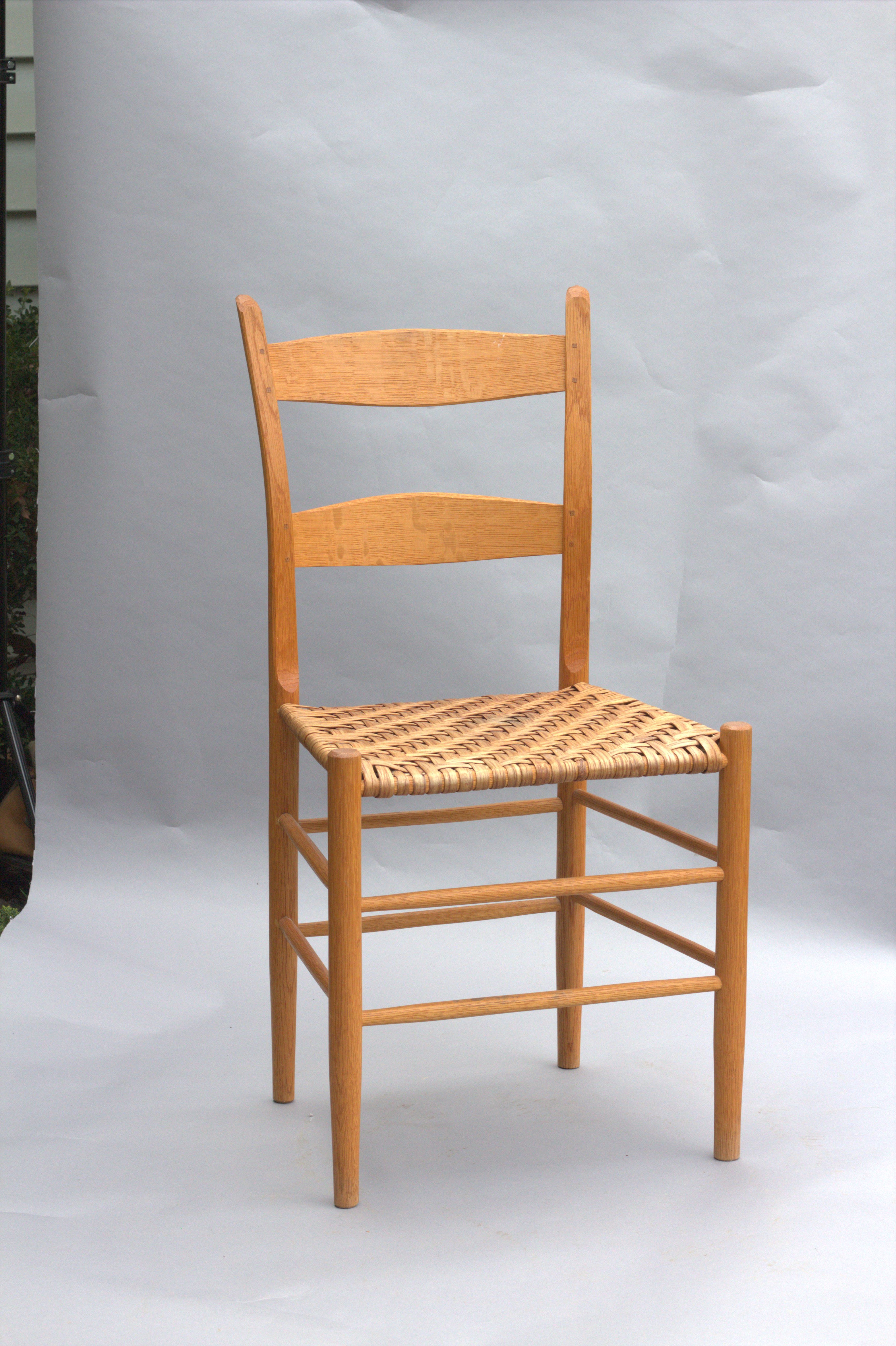
The Alexander chair is a fixture within the craft woodworking community. [quick note; Peter Follansbee makes and teaches the Alexander chair. The chairs are available for purchase through his website. And he teaches the chair in person or though a video series.) The Alexander chair is a focus of chairmaking classes held around the country. When I speak with other craftspeople, it seems the Alexander chair is the most well known of all the ladderbacks. People often use the Alexander name in place of ladderback…as in, “oh, I see you make an Alexander-style chair.” (Even when the chair in reference looks nothing like the Alexander chair).
But in talking with makers who sold the chair to craft fairs, or sold it through other avenues, I heard a different story. It was challenging to sell. One maker said that craft fair audiences couldn’t envision where it fit in their home. Was it a dining chair? A kitchen chair? And did they want to spend on furniture that didn’t have a clear spot?
I receive similar feedback at times from my audiences. Some furniture resonates, other furniture falls flat. Which makes me question, is it in front of the right people?
There are lessons here. Nuance between audiences and interested parties.
It’s utilizing that knowledge that I find tricky.
* short note about the upcoming book. It’s pace will pick up again during the winter. The book is a series of interviews with woodworkers, with furniture making being the common thread. The focus is on *how* they make it work - how they make a livelihood in woodworking. It is not a book where I tell the readers, “This is how you do it to become a successful furniture maker…follow my advice.” Instead, it’ll be a collection of stories about makers and how they do it, about how they found success and longevity in a challenging field.
During the interviews, I ask the furniture makers to share their background, what they do, and how they do it. First, I want to understand their craft and their goals. I need to understand their target…are they focused on their art and will live on whatever income it generates? Or are they focused on starting a Fortune 500-sized operation. The decision making process between these two goals are vastly different.
Then I ask about how they go about doing it. There are stories of success and of frustrations. The makers go to great lengths to find a foothold in woodworking. What I’ve found to this point: it’s personal, and it’s not easy.
You’re asking all the questions I would want to know the answers to! I’m very excited to read your book.
I have found that I need to set aside time and systems to work on sales and marketing, otherwise the making aspect expands to fill all time. Like you, I’ve found that I need to get my work in front of people. Instagram and my web site bring people to my doorstep, but it’s really seeing the processes and handling my work that gets non-makers excited.